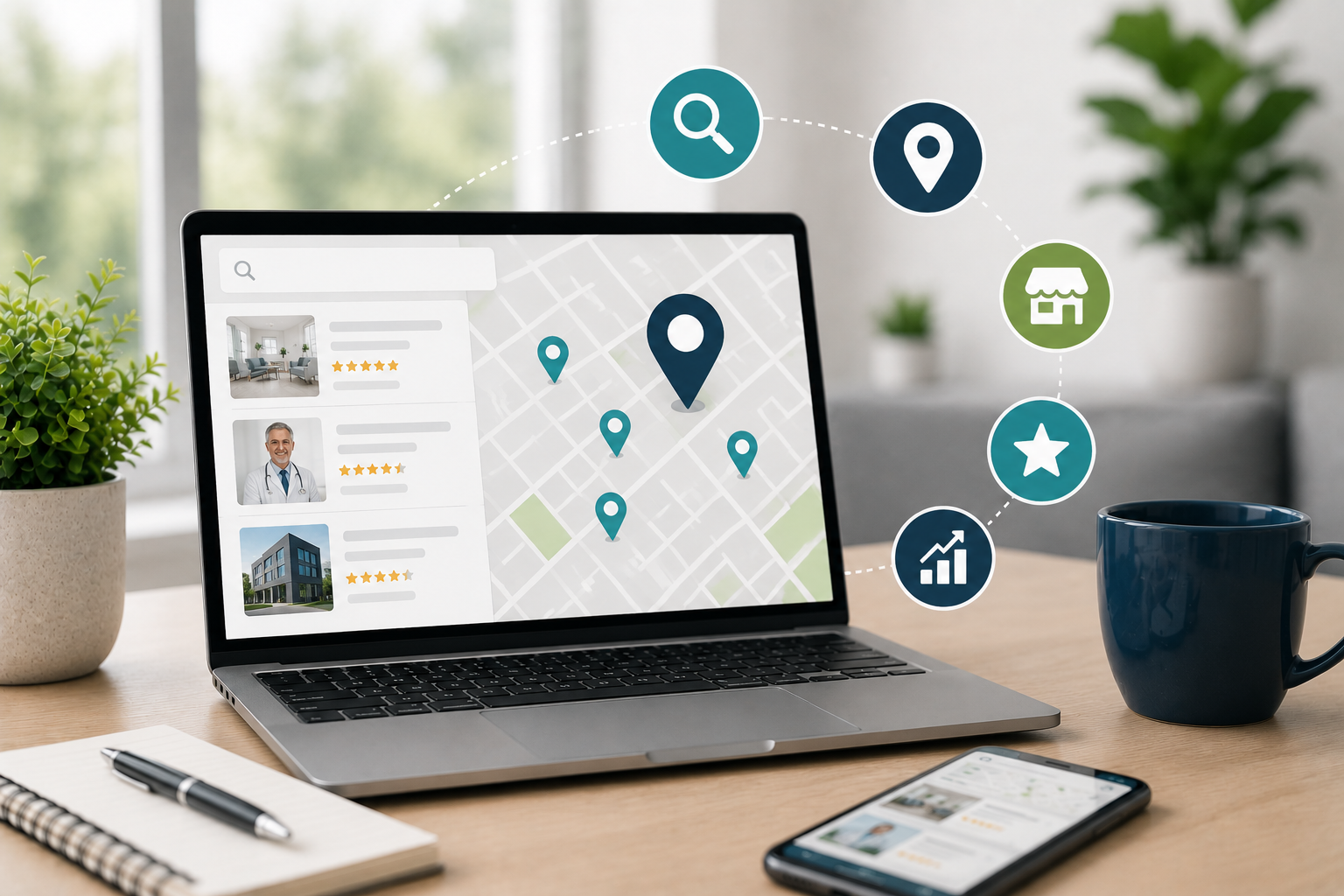
A parent searching for a pediatrician nearby, or an adult looking up a knee doctor in their town, sees a map with three practices listed beside it before anything else. Healthcare local SEO is the work of earning one of those three places. For most practices it is the most valuable ranking available, because the searcher is close by, has a need and is ready to call.
This guide is written for practice owners and managers who suspect their practice is missing from that map and want to know why. It explains the three ideas behind local results in plain terms, then covers the parts you control: your business profile, your location pages, your reviews and your standing in the community.
How the Local Pack Decides Who Appears
Local results are generally understood to turn on three ideas. Knowing which one is holding you back saves a great deal of wasted effort.
Proximity: the factor you cannot argue with
Proximity is the distance between your office and the person searching, or the place they named in the search. You cannot move closer to everyone, so set expectations accordingly. One office will not rank across an entire metro area, and chasing a suburb forty minutes away is usually a losing project. What you can do is make sure the address is exact, the suite number is included, and the map pin sits on your actual entrance.
Relevance: how clearly you match the search
Relevance is whether your profile and website plainly describe what the person asked for. A practice listed under a vague category such as “medical clinic” is a weak match for someone searching for a dermatologist. Categories, listed services and the content on the page your profile links to all feed this.
Prominence: how established you look
Prominence is the search engine’s estimate of how well known and trusted your practice is. Reviews, links from other local websites, mentions in local media and the overall strength of your website contribute. Stronger prominence also tends to widen the area in which you appear, which is the only honest way to soften the proximity limit.
Profile Completeness: The Fastest Win in Healthcare Local SEO
An incomplete business profile is the most common reason a good practice loses to a mediocre one on the map. Work through this list field by field:
- Primary category: the most specific option that fits, with secondary categories for genuine additional service lines.
- Services: every service you want to be found for, named the way patients would say it.
- Hours: regular, holiday and any separate phone or walk-in hours. Wrong hours produce angry reviews.
- Phone and appointment link: a local number that is answered, and a link that lands on a booking or request page.
- Description: who you treat, what you offer and which neighborhoods you serve, written for people.
- Photos: exterior with signage, entrance, parking, waiting room, exam rooms and the team.
- Attributes: accessibility, languages spoken, telehealth availability, new patients accepted.
- Questions and answers: seed the common ones yourself and answer anything the public posts.
Then assign ownership. Whoever changes the office hours should be responsible for changing the profile the same day, and someone should review suggested edits from the public every week.
Local Landing Pages That Deserve Their Ranking
Your profile links to a page on your website, and that page carries much of the relevance signal. For a single-office practice the homepage may do the job. For a group, each office needs its own page, and the profile for that office should link to it instead of the homepage.
A location page worth ranking includes the full address and phone number, hours, the providers who see patients there, the services offered at that site, accepted insurance, parking and transit directions with recognizable landmarks, photos of that specific office, and a short set of questions patients ask about that location. Structured data that labels the page as a medical business with its address and hours helps search engines read it correctly.
Avoid the shortcut of cloning one page for a dozen towns where you have no office and swapping the city name. Those pages are thin, they seldom rank, and they make the site look careless. If patients travel in from nearby communities, say so naturally on the real location page. A team that handles medical web design and ongoing site updates can build these pages from a single template while keeping the content for each office distinct.
Reviews Do Two Jobs at Once
Reviews are a ranking input and a conversion input, and practices often think about only one.
On the ranking side, the count, the freshness and the steadiness of reviews all appear to matter, as do the words patients use. A review that mentions a specific service adds relevance you could never write for yourself. On the conversion side, the searcher is comparing three practices at a glance. The one with a healthy number of recent reviews usually gets the call, even from the third position.
Build a routine instead of running occasional pushes:
- Pick one consistent moment to ask, such as checkout or a follow-up message later that day.
- Send a direct link by text or email so leaving a review takes under a minute.
- Ask every patient, not only the ones you expect to be happy, and never offer anything in exchange. Review platforms generally prohibit selective asking and incentives.
- Reply to every review without confirming that the writer is a patient or referring to any detail of care.
Privacy rules apply to review replies. This is general information and not legal advice, so confirm your reply wording with your compliance counsel.
Local Links and a Visible Place in the Community
Prominence is also earned away from your profile. A link or mention from a respected local organization tells search engines that your practice is part of the area it claims to serve. Useful sources include:
- Chamber of commerce and business association member pages
- Youth sports teams, school programs and charity events you sponsor
- Hospital and health system pages listing affiliated providers
- Local news coverage of a new provider, a new office or a community health event
- Nonprofits and support groups where your providers speak or volunteer
Many of these organizations will mention you and forget the link, so ask for it. One or two real local links a quarter are worth more than any purchased package. Accurate business listings across the web are the baseline underneath all of this, and a directory listings and off-page SEO service can keep that baseline steady while your team focuses on relationships.
A Short Monthly Check
| What to check | Why it matters |
|---|---|
| Search your main services from several spots in your service area | Local rankings change with the searcher’s location, so one search from the office tells you little |
| Calls, direction requests and website clicks from the profile | These are the actions that turn into appointments |
| New reviews and any left unanswered | Freshness and responsiveness both influence the next searcher |
| Hours, holiday closures and suggested edits | Outside edits can change your listing without warning |
Where to Put Your First Hours
Work in this order: complete the profile, start the review routine, build or repair the location pages, then pursue community links. The first two cost almost nothing and often move results soonest, though no one can promise a specific position.
If you would like a second set of eyes, iLoyal Medical provides healthcare SEO services that include local search. You can schedule a free consultation to review how your practice currently appears on the map and what is most likely holding it back.
Frequently Asked Questions
Why does my medical practice not show up in the map results?
The usual causes are distance from the searcher, a category that does not match the search, a thin or unverified profile, too few recent reviews, or a linked web page that barely mentions the service. Start by checking the profile’s category, services and verification status, then look at review volume compared with the practices that do appear.
How long does healthcare local SEO take to work?
Profile corrections such as categories, services and hours can influence visibility fairly quickly, sometimes within weeks. Reviews, location page improvements and local links build over months. Results vary with competition and location, and no reputable provider can guarantee a specific ranking or timeline.
Do patient reviews really affect local rankings for doctors?
Reviews are widely regarded as a meaningful local ranking input, and they clearly affect which listing a searcher chooses. A steady flow of recent reviews tends to help more than a large batch collected long ago. Ask every patient, never offer incentives, and reply without confirming anyone is a patient.
Should each office location have its own page on our website?
Yes. Each office should have a dedicated page with its own address, phone number, hours, providers, services, directions and photos, and that office’s business profile should link to it. This gives search engines a clear match between the listing and the site, and gives patients the details they need.
Can we rank in a nearby city where we have no office?
Sometimes in the regular results, rarely in the map. Proximity to the searcher is a core local factor, so a practice without an address in that city starts at a disadvantage. Building prominence can widen your reach somewhat. Pages that only swap in a city name seldom help.
Let’s Chat!
Tell us what you want to accomplish with your marketing and we’ll connect you with the apps and team that fit you like a glove – even if it’s not iLoyal! Stop spending time searching and let experts guide you toward a marketing tech solution and great service experience.
Call 1-877-347-3376