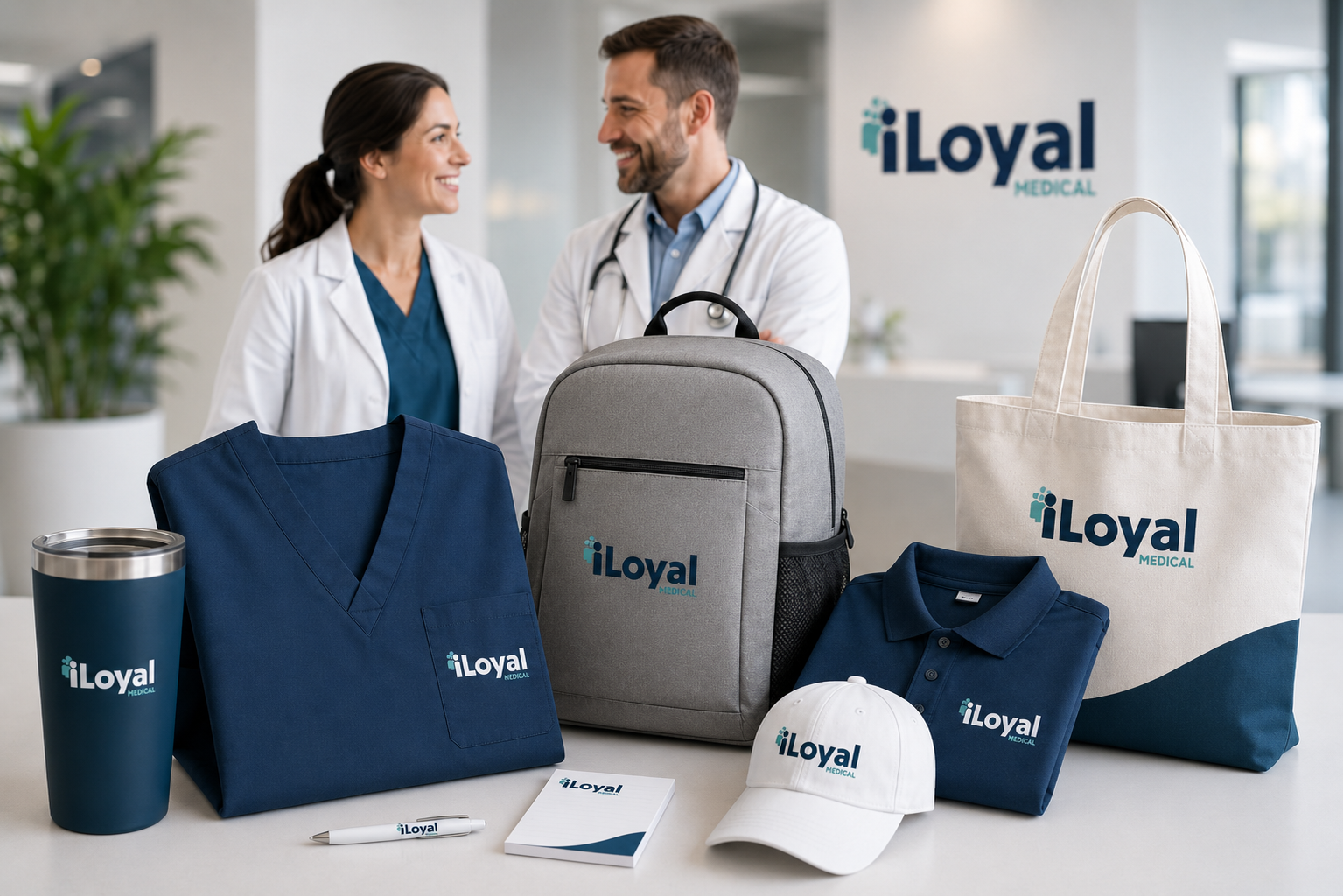
Somewhere in most practices there is a closet holding a box of pens nobody wanted, ordered in a hurry before a health fair years ago. Healthcare promotional products and branded apparel tend to be bought as an afterthought, which is why so much of it becomes clutter instead of carrying the practice’s name into the community.
This article is for practice managers and marketing leads who control a modest merchandise budget and want every item to have a job: making the staff look like one team, keeping referring offices aware of you, giving new patients a good first week, or starting conversations at local events. If an item does none of those, it does not get ordered.
Staff Apparel: The Brand Patients Actually See
Patients spend far more time looking at your team than at your logo on a website. Consistent, well-fitting apparel tells them the practice is organized before anyone says a word, and it answers a question patients are often too polite to ask: who in this room is the nurse, the medical assistant, the front-desk lead?
- Embroider name and role where your dress code allows it. Patients remember “Maria, the surgical coordinator” more easily when it is stitched in front of them.
- Pay for quality once. A jacket that pills after three washes stops being worn, and the embroidery budget goes with it.
- Include outerwear. Fleece and soft-shell jackets get worn to the grocery store and the school pickup line, which is exposure no advertisement buys.
Apparel also works as recognition. A milestone-anniversary jacket or a new-hire bundle waiting on day one costs little and says the practice notices.
One side benefit: coordinated apparel makes team photos look intentional. If you are planning professional photography or video for the practice, get the apparel order delivered first.
Outside the Office: Referral Drop-Offs and Community Events
Referral-office drop-offs
The people who decide where a referral goes are frequently referral coordinators and front-desk staff, not only the physician. A drop-off visit exists to make their job easier. The branded item is the excuse for the visit; the information is the point.
Bring an up-to-date one-page sheet listing your providers, the conditions you see, the plans you accept, your referral fax and direct line, and how to flag an urgent case. Pair it with something that lives on a desk and gets used daily: a pen that writes well, a sticky-note pad, a desk calendar, a phone stand. Print your referral line on the item, not just the logo, because that is the number they will need.
Assign one person to own the route and log each visit. A steady, predictable presence beats an annual basket.
Community events and health fairs
A table with a fitted cloth, a legible banner and staff in matching apparel draws more visitors than a pile of giveaways on a bare folding table. Match the item to the audience. A youth sports sponsorship suits water bottles and drawstring bags. A senior expo suits large-print magnets with your phone number and a jar-opener grip.
Give visitors a way to continue the conversation: a QR code to your appointment request page or a newsletter sign-up with clear consent wording. Do not collect health details on a clipboard lying on an open table. Sponsorships and event appearances also make good local news hooks, and a coordinated public relations effort can extend a Saturday morning into weeks of visibility.
New-Patient Welcome Kits
A welcome kit makes the practice easier to use afterward. The contents that matter most are not merchandise at all:
- A one-page “how to reach us” guide: main line, after-hours instructions, patient portal sign-in steps, refill and billing contacts.
- A refrigerator magnet or card with the phone number and web address.
- One small useful item suited to your patients, such as a tote, a lip balm, a growth-chart poster for a pediatric office, or a notebook for tracking questions between visits.
Hand the same kit to every new patient in a given category instead of reserving it for certain people, and keep the unit cost low. If kits are mailed, remember that outer packaging naming a sensitive specialty can reveal more than a patient wants their household or mail carrier to know. A plain envelope with the practice’s general name is the safer default.
How to Choose Healthcare Promotional Products People Keep
Run each candidate item through four questions before it goes on an order form.
- Will the recipient use it weekly? Utility beats novelty.
- Does it fit the specialty without making a health promise? A sunscreen stick from a dermatology office or a hand sanitizer from a primary care office makes sense. Avoid packaging or slogans that imply a treatment result.
- Would the recipient be comfortable being seen with it? A tote that announces a fertility, behavioral health or urology practice asks patients to advertise something private. Use the practice name and mark alone, or choose an item that stays at home.
- Can the branding be read? Name, phone number and web address in a legible size. A tiny logo in one corner helps nobody find you.
Keeping Gifts Modest and Appropriate
Healthcare is not retail, and gift-giving carries rules that a typical promotional catalog never mentions. In general terms, federal and state laws restrict offering things of value in order to induce referrals or to influence a patient’s choice of provider, especially where government health programs are involved. Hospitals, health systems and professional boards may also limit what their staff are allowed to accept. Low-cost branded items handed out broadly are generally viewed very differently from valuable gifts aimed at people who send you business, but where the line falls depends on the facts.
Sensible guardrails for any practice:
- Keep every item low in value and the same for everyone in the group receiving it.
- Never tie a gift to the number or value of referrals, and never reward a patient for choosing a service.
- Skip cash, gift cards and anything that works like cash.
- Ask referring organizations about their acceptance policies before you deliver anything.
This overview is general information and not legal advice; confirm your gift and giveaway practices with your compliance counsel before placing an order.
Ordering Logistics That Prevent the Closet Problem
Most merchandise disappointments are process failures, not product failures.
- Artwork: keep a vector version of your logo, your exact brand colors and a one-color version for embroidery and small imprints in a shared folder.
- Samples and proofs: handle a physical sample before a bulk order, and have two people check the proof for the phone number and web address.
- Quantities: order against a planned use. As a purely hypothetical example, a practice expecting 40 new patients a month and two community events a quarter can estimate a year’s need on one page and avoid a five-year supply.
- Lead times: decorated apparel and custom items take weeks, and rush fees are steep. Work backward from the event date and add a buffer.
- Ownership: one named person keeps the inventory sheet, the reorder calendar and the vendor relationship.
Planning Your Next Order
Start by emptying the closet and writing down what was never used and why. Then list the four jobs (team identity, referral visits, events, new-patient welcome) and assign each a small budget and an owner for the year. iLoyal Medical provides branded apparel and promotional products for healthcare organizations, and if you would like a second opinion on how merchandise fits your wider marketing plan, you can request a free consultation.
Frequently Asked Questions
What promotional products work best for medical practices?
Items people use every week and are comfortable being seen with: good pens, sticky notes, magnets with the phone number, water bottles, totes, hand sanitizer and desk accessories. The best choice depends on the recipient. Referral coordinators need desk items carrying your referral line, while event visitors and new patients need something useful at home.
Can a medical practice give gifts to referring physicians’ offices?
Modest branded items shared broadly are common, but laws and organizational policies restrict offering things of value to induce referrals, and some offices may not accept anything. Keep items low in value, never link them to referral volume, avoid cash equivalents and check the recipient’s policy. This is general information, so confirm specifics with compliance counsel.
What should go in a new-patient welcome kit?
Lead with information: how to reach the office, after-hours instructions, portal sign-in steps, and billing and refill contacts. Add a magnet or card with the phone number and one small useful item suited to your patients. Give the same low-cost kit to every new patient in a category and use discreet packaging when mailing.
How far ahead should we order branded items for an event?
Work backward from the event date and allow several weeks for proofs, production and shipping, plus a buffer for corrections. Decorated apparel and fully custom items usually take longest. Approve a physical sample first when you can, and have two people proofread the phone number and web address before production starts.
How do we measure whether promotional items are worth it?
Tie each item to its job. For events, count scans of the QR code on your table materials and sign-ups collected. For referral visits, watch whether visited offices keep sending patients and call your direct line. For staff apparel, ask the team. If nobody can name the job an item does, stop reordering it.
Let’s Chat!
Tell us what you want to accomplish with your marketing and we’ll connect you with the apps and team that fit you like a glove – even if it’s not iLoyal! Stop spending time searching and let experts guide you toward a marketing tech solution and great service experience.
Call 1-877-347-3376