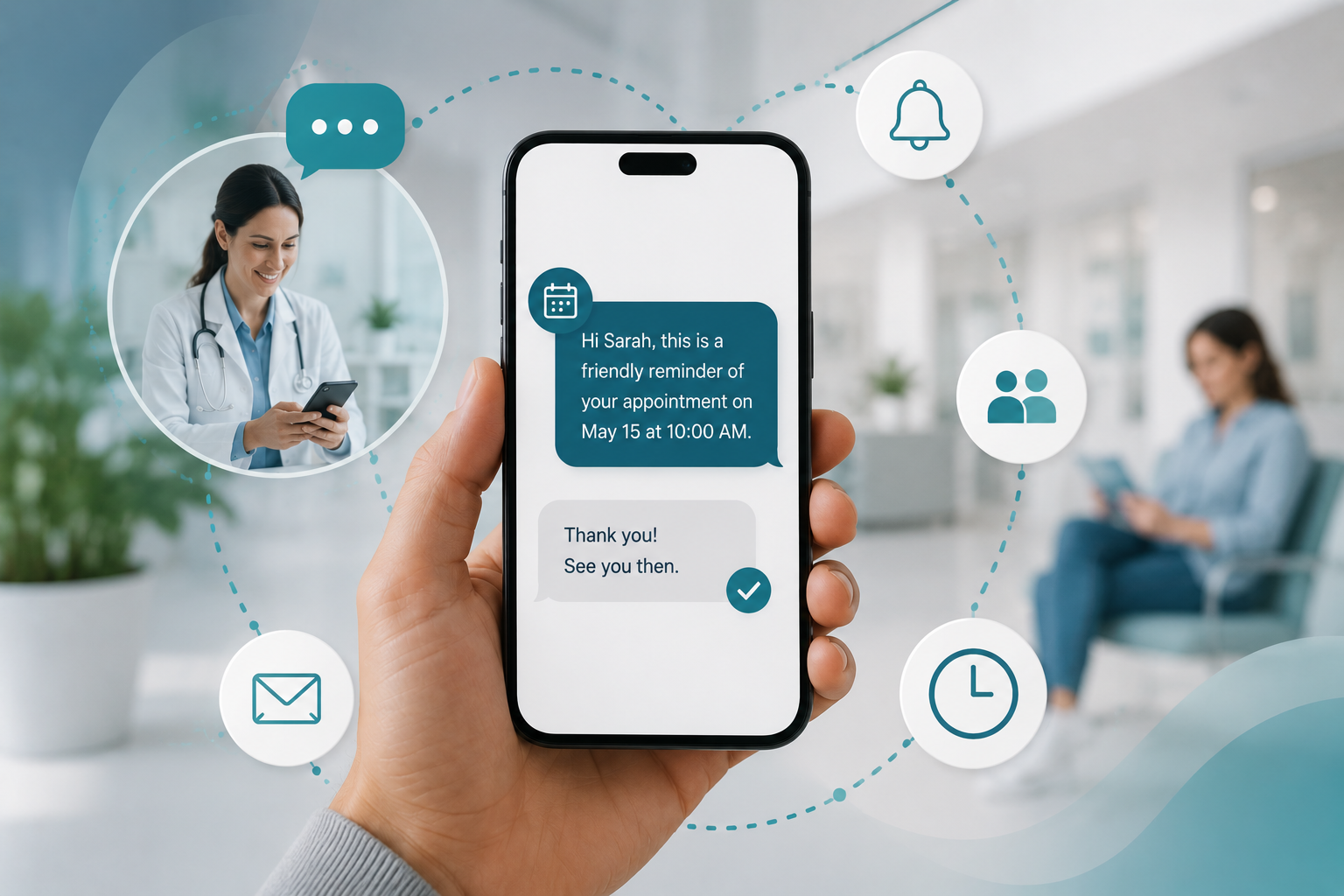
Text messages get read. That is the whole appeal of SMS marketing for medical practices, and also the whole risk. A channel this personal punishes carelessness quickly: one message to the wrong list, one text that reveals too much on a lock screen, and patients start opting out or complaining.
If you manage a practice and want texting to be a dependable part of patient communication, not an occasional blast, this is for you. It treats texting as a program with rules, covering permission, content, timing, replies and measurement. Appointment reminders appear only in passing, since reducing no-shows is its own subject.
What SMS Marketing for Medical Practices Should and Should Not Do
Texting is good at short, timely, useful messages to people who already know you. It is poor at persuasion, long explanations and reaching strangers. Practices that do well with it write down a narrow purpose first, such as keeping existing patients informed and prompting overdue visits, and refuse everything outside it.
That purpose statement also settles internal arguments later. When someone suggests texting the entire list about a new product line, you can ask whether it fits the purpose patients agreed to.
Consent, Opt-In and Opt-Out in General Terms
Two sets of expectations overlap here. Telecommunications and consumer protection rules, along with mobile carriers’ own requirements, generally expect a business to have a person’s permission before texting them, and they tend to hold promotional messages to a stricter, documented standard than purely informational ones. Separately, health privacy rules restrict using patient information for marketing without authorization in many situations. Neither framework forbids texting patients. Both reward practices that ask clearly and keep records.
In practical terms:
- Ask explicitly. Add a texting consent to intake paperwork and online forms, in plain words, separate from other consents. Say what kinds of messages the patient will get and roughly how often.
- Separate the permissions. Let patients agree to visit-related texts without agreeing to promotional ones. Many will say yes to the first and no to the second, and that choice should be respected in your lists.
- Record it. Store when and how consent was given. A checked box with a date is far better than a staff member’s memory.
- Make leaving easy. Every promotional text should identify the practice and explain how to stop, typically by replying STOP. Honor opt-outs right away and make sure they carry across every system that sends texts.
- Do not text purchased or borrowed lists. Ever.
This section is general information, not legal advice. Rules differ by state and change over time, so have your compliance counsel review your consent wording and your vendor’s setup before the first campaign.
Message Types Worth Sending
| Message type | Example wording | Notes |
|---|---|---|
| Recall prompt | “Hi from [Practice Name]. Our records show it may be time to schedule a visit. Call or reply to book.” | No mention of the visit type or reason. |
| Schedule openings | “We have appointments open this week. Reply or call if you would like one.” | Send only to patients who asked to be notified. |
| Operational notice | “Our office opens late tomorrow due to weather. We will contact you if your appointment is affected.” | Useful, brief, no promotion attached. |
| Review or feedback request | “Thank you for visiting us today. Would you share your experience?” | Same-day, one reminder at most. |
| Practice news | “We have added Saturday morning hours. Details on our website.” | Promotional consent needed. |
| Event or seasonal service notice | “Sports physical appointments are now open for booking.” | General availability, not targeted by condition. |
Notice what the messages share: each could be read aloud in a crowded room without embarrassing anyone.
What Never Goes in a Text
Assume every text will be seen by someone other than the patient, because phones sit face-up on desks and previews appear on lock screens. Standard text messaging is also not a secure channel. Keep these out:
- Diagnoses, conditions, test results, medication names or procedure names.
- The specialty or visit reason when it reveals something by itself, such as a text naming a fertility, oncology or behavioral health service.
- Balances owed with itemized detail. A neutral note that a statement is ready, with a link to a secure online payment portal, is the safer pattern.
- Promotions aimed at a segment built from health information, where the offer itself tells an onlooker what the patient was treated for.
- Claims about what a treatment will achieve, or urgency tactics such as countdown pressure.
- Requests that the patient reply with insurance numbers, dates of birth or card details.
When a message needs detail, the text should point somewhere secure, such as the portal or a phone call, and say nothing more.
Timing and Frequency
Send during ordinary daytime hours in the patient’s time zone, on weekdays unless the message is operational. Early mornings, late evenings and holidays generate opt-outs and, in some places, run into legal quiet-hour limits.
For frequency, think in terms of a budget per patient. Visit-related messages happen as needed. Promotional and news texts should be rare enough that each one feels worth opening; for most practices that means occasional, not weekly. Longer updates belong in email newsletters for patients, where there is room to explain and no buzz in someone’s pocket. Watch your opt-out count after each send. If one message causes a spike, it was either irrelevant or sent too soon after the last one.
When Patients Text Back
Patients reply to texts, even ones marked “do not reply.” Plan for it:
- Use a platform where replies land in a monitored queue, and assign a person to it during office hours.
- Set an automatic after-hours reply stating when the office will respond and directing emergencies to emergency services.
- Prepare short staff responses for the common cases: booking, rescheduling, directions, and a polite redirect when a patient starts describing symptoms. For example: “Thanks for letting us know. For your privacy we would like to discuss this by phone. What is a good time to call?”
- Make sure keywords such as STOP and HELP work automatically, without waiting for a human.
A reliable platform and process matter more than clever copy. Practices that lack the staff time to run this themselves often hand it to a partner offering SMS marketing services for healthcare, while keeping reply handling with the front office.
What to Measure, and Your Next Move
Skip vanity numbers. A texting program earns its keep when it produces booked visits without driving people off the list. Track four things monthly: delivery failures (which reveal bad phone numbers to correct at check-in), opt-outs per send, replies handled and how fast, and appointments booked by patients who received a recall or openings text. A simple hypothetical shows the logic: if a recall text goes to 200 overdue patients and 18 book within two weeks, compare that with how many of a similar group booked without a text. The difference is what the program is worth.
Before sending anything new, pull out your current consent form and read it as a patient would. If it does not plainly say what you intend to send, fix that first. iLoyal Medical can help you design the program, from consent wording for your counsel to review through message templates and reporting. Request a free consultation to talk it through.
Frequently Asked Questions
Is SMS marketing allowed for medical practices?
Generally yes, when it is done with proper permission and careful content. Practices are expected to obtain consent before texting, offer an easy way to opt out, and avoid using or revealing protected health information inappropriately. Requirements vary by state and situation, so this is general information and your compliance counsel should confirm your specific program.
Do we need separate consent for appointment texts and promotional texts?
It is wise to treat them separately. Promotional messages are typically held to a stricter, documented consent standard than informational messages about a patient’s own care. Offering two checkboxes lets patients accept visit-related texts while declining marketing, keeps your lists clean, and gives you a clear record if a question ever comes up.
How often should a medical practice text its patients?
Visit-related texts go out as needed. Promotional or news texts should be occasional, and only when the message is useful enough to justify interrupting someone’s day. Monitor opt-outs after every send. A rising opt-out count is the clearest sign you are texting too often or sending messages that do not matter to the recipients.
Can we mention a patient’s condition or treatment in a text message?
Avoid it. Text messages can be seen by others and standard SMS is not a secure channel. Keep texts free of diagnoses, procedures, medications and results, and be careful that the practice name or offer does not reveal sensitive information by itself. Direct patients to a secure portal or a phone call for anything detailed.
What should we do when a patient replies to a text with a medical question?
Acknowledge the message, avoid discussing clinical details by text, and move the conversation to a phone call or your secure portal. Give staff a short prepared response for this situation. Your automatic after-hours reply should also tell patients to contact emergency services for emergencies, since a text queue is not monitored for urgent needs.
Let’s Chat!
Tell us what you want to accomplish with your marketing and we’ll connect you with the apps and team that fit you like a glove – even if it’s not iLoyal! Stop spending time searching and let experts guide you toward a marketing tech solution and great service experience.
Call 1-877-347-3376